JWT vs session authentication, which one to pick
Sessions can be revoked; JWTs verify themselves. Watch one request take each path, then pick the trade-off that fits what you are building.
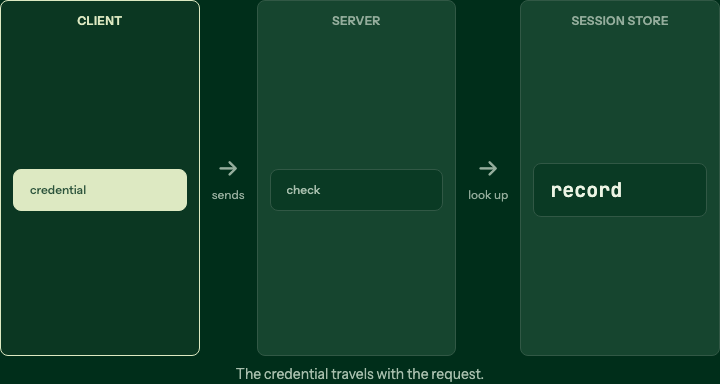
A request arrives with a credential
Every request carries a credential: a session cookie, or a JWT.
Step 1 of 4
Almost every "should I use JWT?" argument is really an argument about one thing: what happens when you need to log someone out right now. Step through the scene above to see where the two approaches actually differ.
What each one actually is
A session is a record the server keeps. The client holds a meaningless id (in a cookie), and the server looks that id up in a store on every request. The state lives on the server.
A JWT is the opposite. The client holds a token that carries its own data and a signature. The server checks the signature and trusts the contents. Nothing is looked up, because the state lives in the token.
// A session cookie is just a key:
Cookie: sid=8f3c...           // the server owns the record

// A JWT carries the data itself:
Authorization: Bearer eyJ...  // header.payload.signature
The trade-off that decides it
Because a session is a record, deleting it revokes access instantly. Because a JWT verifies itself, it stays valid until it expires, no matter what happens on the server. That single difference drives the rest: sessions cost a lookup but give you control; JWTs skip the lookup but make "log out everywhere" hard.
Read the OWASP session management guidance for the security details, then work through the lesson to see the revocation problem play out end to end.
Common questions
- Which one is more secure?
- Neither by default. A stolen session cookie and a stolen JWT both grant access. The real difference is how quickly you can shut that access off.
- Can I revoke a JWT?
- Not directly. You either keep the expiry short, or add a deny-list the server checks on each request, which is a store, the very thing JWTs were meant to avoid.
- What should I default to?
- For a single app with a login, sessions are simpler and revocable. Reach for JWTs when several services must verify a token without sharing one session store.
Keep reading
Blocking vs non blocking in Node, watch the thread pool
One readFileSync freezes every user on your server. Watch the thread stop on one line, then hand the read to a worker and answer everyone else meanwhile.
401 vs 403, the difference in one request
401 means the server doesn't know who you are; 403 means it does, and the answer is no. Watch one request hit both gates.
Express middleware explained, step by step
Middleware is a line of functions every request walks before your handler. Watch three stations stamp one request in order, then a missing token stop it early.